PDF Download UML Bible
When offering UML Bible as one of the collections of many publications below, we assume that it can be one of the very best books provided. It will certainly have many fans from all nations readers. As well as exactly, this is it. You could truly expose that this publication is what we thought initially. Well currently, let's seek for the other publication title if you have actually got this book review. You might find it on the search column that we supply.
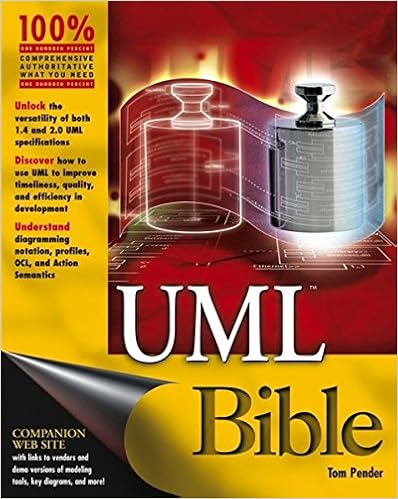
UML Bible

PDF Download UML Bible
Schedule, truth good friend of your own while remaining in a lonesome time. Book, is a buddy for you to go along with when remaining in a tough time of task due date. Book is a fashion that you should hold everyday making much better future. When somebody is leading to obtain numerous activities and also you have few times freely, it will certainly be much better for you to invest it sensibly.
Feel hard to get this best seller book? Why? We think that best seller publication will always run out swiftly. So, it's not to strange when you will certainly really feel difficult to get it in guide store, or you should bespeak UML Bible when you need it. Have adequate time? Not everyone can wait for log minute to get guide. To overcome this problem, we are right here to give you solution. It is not actually hard for us. We definitely help you by offering the checklists of the new best seller books on the planet.
As pertaining to this referred book, you may have understood why this book is awaited. However, for you that are still interested of the factors, you will realize he reasons when you begin to check out the book. Considering the cover of UML Bible and also check out title will certainly lead you recognize why lots of people falling in love. Keen on the book that pertaining to the topic you are looking for could make you feel satisfied. This is exactly what will certainly make you fill that desire.
Based on this problem, in order to help you we will show you some means. You can handle to review guide minimally prior to falling asleep or in your leisure. When you have the time in the short time or in the holiday, it could help you to finish your vacations. This is just what the UML Bible will minimally offer to you.
From the Back Cover
If UML can do it, you can do it too... Today’s economy demands top quality software development in record time and with maximum efficiency. UML arms you to meet that challenge, and the UML Bible supplies the most comprehensive UML education you can get. One volume covers everything from understanding and using UML and diagramming notation to the object constraint language (OCL) and profiles, in both 1.4 and 2.0 UML specifications. It’s the one resource you can rely on to virtually guarantee your success. Inside, you’ll find complete coverage of UML Learn to model object structure, interactions, behavior, and architecture using UML Explore diagram structure and usage Understand how to utilize the overlapping features of the UML diagrams to facilitate the modeling process Learn to exploit the features of the UML diagrams to test them for consistency and accuracy Learn to assess modeling tools to choose the one that suits your needs Comprehend how the statechart diagram is used to model changes in an object over its lifetime Apply object constraint language (OCL) and work with Action Semantics to specify behaviors that ultimately will be implemented in code Understand the XML Model Interchange (XMI®) standard that helps enable model sharing between modeling tools and other XMI-compatible applications Customize UML to meet the needs of specific industries or application types
Read more
About the Author
Tom Pender has been working in software development for over 22 years. Most recently he has author six courses on the UML which he has taught throughout the U.S. and 12 other countries. He has also spent the last four years teaching and consulting with companies who are transitioning to object-oriented technologies. Prior to that, his software development roles included everything from programmer to manager, teacher, writer, business systems analyst, and consultant. His work has spanned wholesale and retail distribution, investing, insurance, accounting, international shipping, embedded phone applications, materials management, and coal mining.
Read more
Product details
Paperback: 984 pages
Publisher: Wiley; 1 edition (September 26, 2003)
Language: English
ISBN-10: 0764526049
ISBN-13: 978-0764526046
Product Dimensions:
7.5 x 2.1 x 9.2 inches
Shipping Weight: 3.8 pounds
Average Customer Review:
4.5 out of 5 stars
10 customer reviews
Amazon Best Sellers Rank:
#1,654,091 in Books (See Top 100 in Books)
Wouldn't want to document a design without this book.
If you are at all involved with the use of UML in your programming or analysis activities, you'll most likely be interested in seeing the UML Bible by Tom Pender (Wiley). Like all 'Bible' titles from Wiley, this book covers a wide range of topics that should give you most any answer you need to find.The chapter breakout is in seven parts:Part 1 - An Introduction to UML - What Is UML?; UML Architecture; UML Diagrams and Extension Mechanisms; Object-Oriented ConceptsPart 2 - Modeling Object Structure - Capturing Rules about Objects in a Class Diagram; How to Capture Rules about Object Relationships; Testing With ObjectsPart 3 - Modeling Object Interactions - Modeling Interactions in UML 1.4; Modeling Interactions in UML 2.0; Modeling an Object's Lifecycle in UML 1.4; Modeling an Object's Lifecycle in UML 2.0Part 4 - Modeling Object Behavior - Modeling the Use of a System with the Use Case Diagram; Modeling Behavior Using an Activity DiagramPart 5 - Modeling the Application Architecture - Using Packages; Modeling Software Using the Component Diagram; Using Deployment Diagrams in UML 1.4; Using Deployment Diagrams in UML 2.0Part 6 - Bringing Rigor to the Model - Applying Constraints to the UML Diagrams; Action SemanticsPart 7 - Automating the UML Modeling Process - Using a Modeling Tool; Customizing UML Using Profiles; XML Metadata InterchangeAppendices - UML 1.4 Notation Guide; UML 2.0 Notation Guide; Standard Elements; Glossary; IndexNow, I'm not a UML expert by any stretch of the imagination. But based on what I have read and studied to date, this book covers everything. Taking the Use Case chapter as an example, I can see that there is an abundance of technical detail and diagramming to explain the topic completely. Couple this chapter with the notation guide in the back, and you have a reference guide that is hard to beat. At the time this book was written, UML 2.0 wasn't yet released. But the author takes the specs that should be part of the final release and explains how those features are different than UML 1.4. As a result, you shouldn't outgrow this book anytime soon.The only quibble I have with the book is the audience that the author says he is targeting. Readers new to object-oriented analysis are expected to be able to get an in-depth understanding of UML and be able to become a productive member of a team by reading this book. In my opinion, that may be a bit of a reach. If I had no UML experience, I'd find this book very daunting in both the size and complexity of the material. My recommendation would be to find an entry level UML book, and work through it before tackling this book. With the UML fundamentals fresh in your mind, you'll be able to come at this book from a much better position and benefit much more quickly.Overall, a good book to have around...
The book is laid out very well, starting with a review of UML and provides thorough and detailed descriptions of all the diagrams and notations. I'm using this nearly exclusively to help me model projects, and is on my desk instead of on my bookshelf.The author clearly understands UML and takes the reader effectively through the distinctions between the many notations.Pluses- Excellent description on the differences between UML 1.4 and 2.0, including completely different chapters where necessary- Detailed descriptions of all the notations including less often used pieces- Explicit definitions of key terms that limit confusion created from the "common understanding" of the definitions- Excellent example that runs through the entire book, with appropriate departures to clarify points.- Valuable introduction to the Object Constraint Language (OCL) and action semantics- Most information that belongs in the appendix / late chapters is there (see below)A few dings -First, I would have to agree with Mr. Duff's comments on the target audience - I'm fairly experienced with Object Oriented programming and with design work, but when I tried to read this, I started getting confused and very sleepy. I started out with UML for Dummies and this made life much easier.Second, the author included an early chapter and 50 pages throughout the book to the architecture and formal definition of UML. Frankly, I'm not sure who is really interested in the definition of the UML 1.4 four layer architecture model and the UML 2.0 superstructure library, but to me the bigger sin is to put it in chapter 2 instead of an appendix / later chapter. I didn't gain anything except a headache by reading about it earlier in the book.Third, although he is very clear about it through the book, the version that I have came out before the final specification. This may cause some things to be different from his version to the final specification. However, he details those specifically, gives the likely outcomes, and the detailed areas are in the hinterlands of UML.
This book is highly recommended because not only is it clearly written, but it is also a comprehensive treatment of the full UML standard, including OCL, XMI and Action Semantics. In addition, an early chapter is devoted to explaining object-oriented concepts, so the UML is put into the right context and not just treated as a notation.Because of the thorough comparisons made between UML 1.4 and UML 2.0, the UML Bible will ease the transition for many modelers to the latest, substantially revised version of the standard.The chapter on OCL is very readable and makes this difficult topic a little easier for most people to appreciate.The chapter on XMI is really just an introduction to the topic, but this chapter does include a very nice introduction to Diagram Interchange, a cool addition to UML 2.0.Other highlights of UML Bible:* Appendices include very usable notation guides, one for UML 1.4 and another for UML 2.0.* A concise glossary that includes diagrams is included at the back.* One major example dominates the book, a Ticketing System.* A companion web site provides useful links and downloads.
UML Bible PDF
UML Bible EPub
UML Bible Doc
UML Bible iBooks
UML Bible rtf
UML Bible Mobipocket
UML Bible Kindle
0 komentar:
Posting Komentar